Go to "Query panel" section by clicking it on the menu or in the home page at the bottom. The following form will show up:

-
Cancer type drop down box: Contains the 14 cancer types available.
TMBpred server will indicate the genes or exons that should be sequenced to estimate tumor mutation burden in the cancer type you have selected. -
Optional: Email address.
In case you complete this field, you will receive an email when the proccess is initializing and other email once it is finished, including your JOB ID. This code will let you follow to the results.
Go to "Predict TMB >> By Amount of Mutations" by clicking it on the navbar or in the home page at the bottom. The following form will show up:
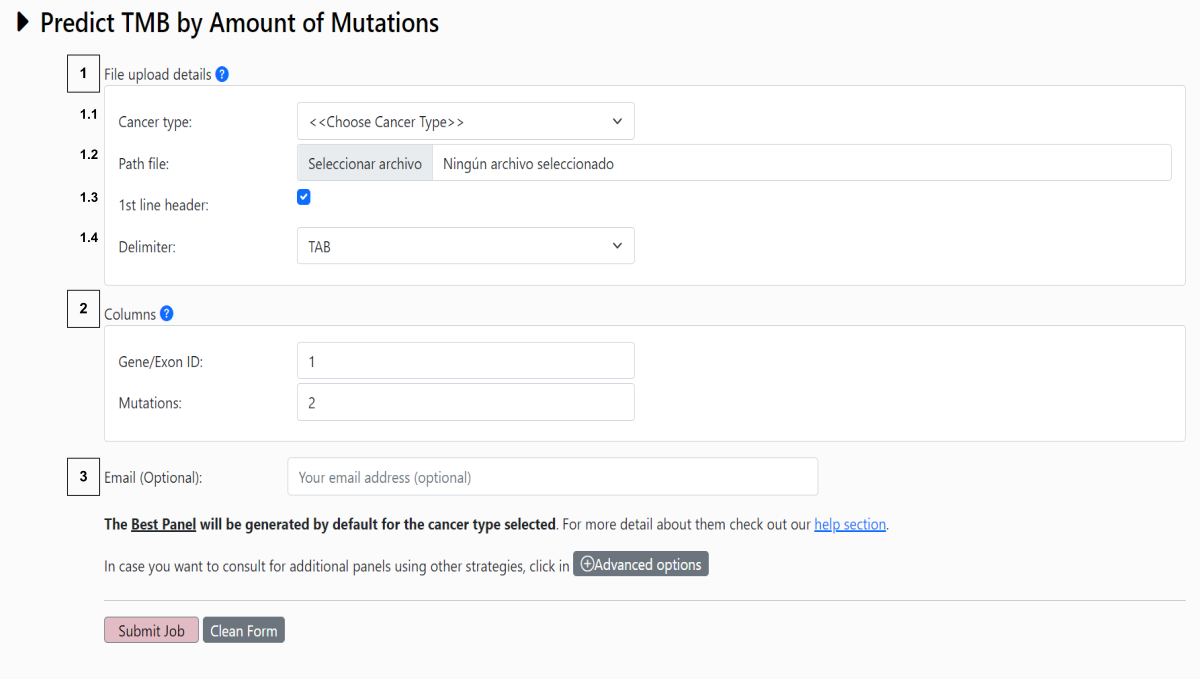
- File upload details:
- Cancer type drop down box: Contains the 14 cancer types available. You have to select one from the list which corresponds to the cancer type of your query.
- Path file: Supported extension txt/csv/tsv. Additionally, the file could be uploaded compressed as zip/tar/tar.gz/tgz. It must include at least 2 columns which contain:
- Identification of the sample. It can include alphanumeric characters,"_","-","."
- All mutated gene/exon ID in the sample. Identificators by Human Gene Nomenclature Committee (HGNC) and Ensembl are allowed.
- All number of mutations per gene/exon ID per sample. Only integer values are allowed.There is no discrimination between indels, SNPs, CNV, synonym or non-synonym mutations. It is count the mutation event in the gene whatever the nature of it.
For instance, if a gene has 1 indel, 1 missense and 1 non-synonym change, the total mutations are 3 (three) for that gene.
- 1st line header: you must indicate whether your file has header or no. In case it has, you have to enable the field. By default is enable.
- Delimiter: Select the separator type of your data file.
- Columns: You must indicate the column position from you input file of the columns "Gene/Exon ID" and "Mutations". It is not mandatory to have the same name columns. For example, if the data has the following columns order:
Therefore, Sample ID = 1 Gene/Exon ID = 5 Mutations = 6
Sample Date Sex Cancer Type Gen ID Mutations - Optional: Email address.
In case you complete this field, you will receive an email when the proccess is initializing and other email once it is finished, including your JOB ID. This code will let you follow the results.
Go to "Predict TMB >> By Genomic Coordenates" by clicking it on the navbar or in the home page at the bottom. The following form will show up:
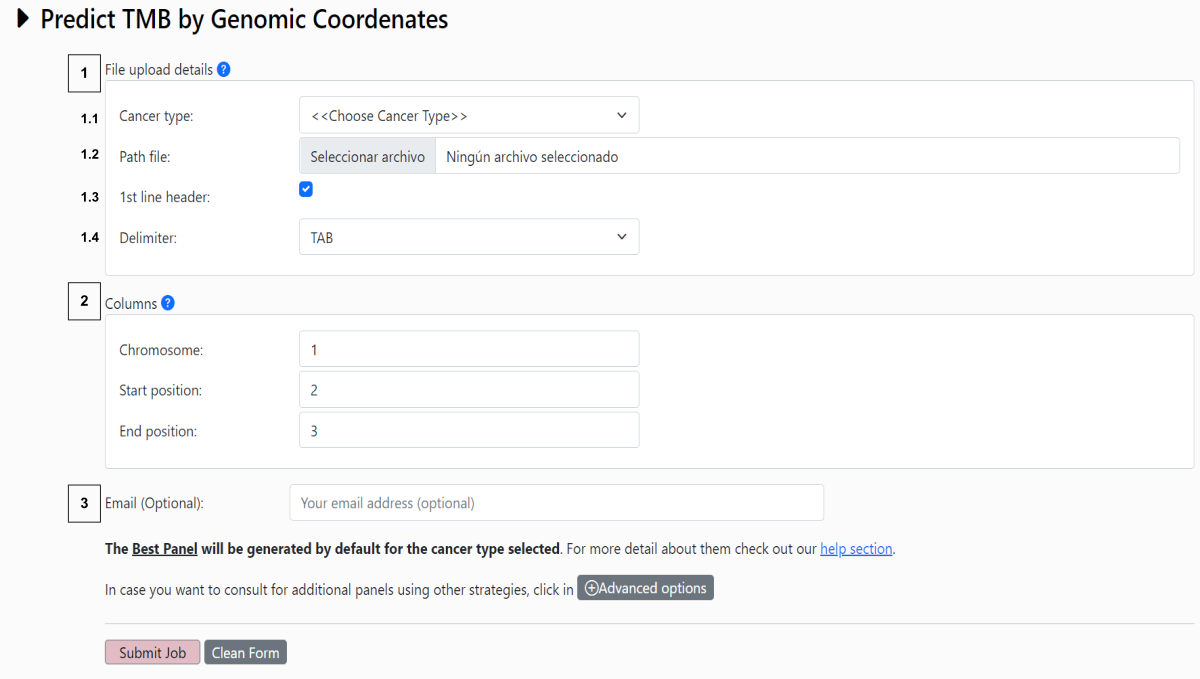
- File upload details:
- Cancer type drop down box: Contains the 14 cancer types available. You have to select one from the list which corresponds to the cancer type of your query.
- Path file: Supported extension txt/csv/tsv. Additionally, the file could be uploaded compressed as zip/tar/tar.gz/tgz. It must include at least 2 columns which contain:
- Identification of the sample. It can include alphanumeric characters,"_","-","."
- All mutated gene/exon ID in the sample. Identificators by Human Gene Nomenclature Committee (HGNC) and Ensembl are allowed.
- All number of mutations per gene/exon ID per sample. Only integer values are allowed.There is no discrimination between indels, SNPs, CNV, synonym or non-synonym mutations. It is count the mutation event in the gene whatever the nature of it.
For instance, if a gene has 1 indel, 1 missense and 1 non-synonym change, the total mutations are 3 (three) for that gene.
- 1st line header: you must indicate whether your file has header or no. In case it has, you have to enable the field. By default is enable.
- Delimiter: Select the separator type of your data file.
- Columns: You must indicate the column position from your input file of the columns "Chromosome", "Start position", "End position". It is not mandatory to have the same name columns. For example, if the data has the following columns order:
Therefore, Start_position = 5 End_position = 6Chromosome = 7
Sample Cancer Type Sex Date Start position End position Chromosome - Optional: Email address.
In case you complete this field, you will receive an email when the proccess is initializing and other email once it is finished, including your JOB ID. This code will let you follow the results.
When you press on "Advanced Options" this box will show up:

- Quality:It refers to the panels/models accuracy with respect to the correlation with experimental TMB (by Spearman's rank correlation and linear regression), and the error (expressed as relative standard error):
- BEST : Panels that show the highest accuracy and lowest error. There is one panel for each malignance
- SUGGESTED (best + suggested): Feasible panels. It also includes the best panels.
- ALL (best + suggested + all): This option includes both mentioned above and other panels.
- Data by: It refers to use mutations in genes, exonsor both to calculate TMB.
Models using Exons can be only selected for the option "All" in "Quality". - Subset: It refers to three strategies differing in the selection of gene/exon followed by Our (our strategy), Cancer Gene Census and Foundation-one Panel to make de models.
For further information about the variables of the model, the selection of genes and samples for the development of panels:
"Panels and models for accurate prediction of tumor mutation burden in tumor samples."
Authors: Martínez-Pérez, E., Molina-Vila, M.A. & Marino-Buslje C.
Journal: NPJ Precision Oncology. 5, 31 (2021)
DOI: 10.1038/s41698-021-00169-0
Once you press "Submit Job" in any of the previous forms, the process will initiate and this message will appear:

- Job ID: This code represents your query, you will need it to retrive the results.
- Status: The status is "PENDING" while the job is being proccess. "SUCCESS" when the job is completed without errors. "FAILURE" when error(s) avoided the process to be completed.
- Date Done:
- If you wish, you can wait for the results as the page will automatically relod every 5 minutes. However, the duration of process will depend on the amount of data to be analyse.
- Alternatively, you can close the window and continue working with your computer and retrive the results later. The data will be storage for 7 days after the job execution, afterwards the job will be eliminated.
Go to "Job Status" by clicking it on the navbar. If the Job ID is valid, you can indicate the code here, it will let you follow the status of the analysis (PENDING, SUCCESS, FAILURE).
- Finally, if the process has ended (STATUS = SUCCESS or STATUS = FAILURE) you can download the results as a tar.gz file.
As an example, here is shown a process completed succesfully.
Job ID: The code of the query.
Status: The job was completed without errors.
Date Done: It indicates the date and hour when the proccess was completed.
These are the 14 malignances available for the analysis, each one has a three-letter ID that identifies it.
| ID | Cancer Type |
|---|---|
| BRE | BREAST CARCINOMA |
| COL | COLORECTAL CARCINOMA |
| END | ENDOMETRIAL CARCINOMA |
| GAS | GASTRIC CARCINOMA |
| GLI | GLIOMA |
| HAV | HEAD AND NECK TUMOR |
| LIV | LIVER CARCINOMA |
| MEL | MELANOMA |
| NME | NON-MELANOMA SKIN TUMOR |
| NSL | NON-SMALL CELL LUNG CARCINOMA |
| OVA | OVARIAN SEROUS CARCINOMA |
| PAN | PANCREATIC TUMOR |
| PRO | PROSTATE CARCINOMA |
| UNI | URINARY TRACT OTHER |
To facilitate the implementation in the clinical setting, we generate cancer-specific consensus panels using our strategy selection of genes.
All of them have R2>0.8 (correlation coefficient) and RSE (relative standard error) less than the median TMB
by cancer type. Additionally, panels were subjected to rigorous internal and external in silico validations
and those showing the highest accuracy were called "BEST MODEL" and other feasible options were called
"SUGGESTED MODEL".
The genes contained in the 39 total panels to estimate TMB accurately for each of the 14 cancer types listed before and the sizes(Mb) are presented in
the following table:
| ID | Cancer Type | ID panel | Classification | Genes per panel | size (Mb) |
|---|---|---|---|---|---|
| BRE | BREAST CARCINOMA | 941 | Suggested Model | 65 | 0.5980 |
| BRE | BREAST CARCINOMA | 969 | Suggested Model | 93 | 0.7963 |
| BRE | BREAST CARCINOMA | 997 | Suggested Model | 123 | 0.9889 |
| BRE | BREAST CARCINOMA | 1020 | Suggested Model | 146 | 1.1550 |
| BRE | BREAST CARCINOMA | 1073 | Best Model | 199 | 1.4912 |
| COL | COLORECTAL CARCINOMA | 1127 | Suggested Model | 51 | 0.3804 |
| COL | COLORECTAL CARCINOMA | 1156 | Suggested Model | 80 | 0.5831 |
| COL | COLORECTAL CARCINOMA | 1185 | Suggested Model | 109 | 0.7881 |
| COL | COLORECTAL CARCINOMA | 1226 | Suggested Model | 150 | 0.9988 |
| COL | COLORECTAL CARCINOMA | 1255 | Best Model | 180 | 1.1002 |
| END | ENDOMETRIAL CARCINOMA | 1102 | Best Model | 33 | 0.2342 |
| GAS | GASTRIC CARCINOMA | 2185 | Suggested Model | 62 | 0.3988 |
| GAS | GASTRIC CARCINOMA | 2203 | Best Model | 80 | 0.4915 |
| GLI | GLIOMA | 899 | Suggested Model | 73 | 0.3897 |
| GLI | GLIOMA | 922 | Best Model | 98 | 0.5161 |
| HAV | HEAD AND NECK TUMOR | 2240 | Suggested Model | 58 | 0.3719 |
| HAV | HEAD AND NECK TUMOR | 2271 | Best Model | 89 | 0.5572 |
| LIV | LIVER CARCINOMA | 1411 | Suggested Model | 47 | 0.3879 |
| LIV | LIVER CARCINOMA | 1438 | Suggested Model | 74 | 0.5937 |
| LIV | LIVER CARCINOMA | 1472 | Suggested Model | 108 | 0.7914 |
| LIV | LIVER CARCINOMA | 1504 | Suggested Model | 140 | 0.9752 |
| LIV | LIVER CARCINOMA | 1539 | Suggested Model | 176 | 1.1760 |
| LIV | LIVER CARCINOMA | 1594 | Best Model | 231 | 1.4763 |
| MEL | MELANOMA | 2044 | Suggested Model | 48 | 0.3963 |
| MEL | MELANOMA | 2082 | Suggested Model | 86 | 0.5915 |
| MEL | MELANOMA | 2121 | Best Model | 126 | 0.7875 |
| NME | NON-MELANOMA SKIN TUMOR | 2152 | Best Model | 40 | 0.2499 |
| NSL | NON-SMALL CELL LUNG CARCINOMA | 1659 | Suggested Model | 96 | 0.5970 |
| NSL | NON-SMALL CELL LUNG CARCINOMA | 1695 | Suggested Model | 132 | 0.7907 |
| NSL | NON-SMALL CELL LUNG CARCINOMA | 1737 | Best Model | 175 | 0.9655 |
| OVA | OVARIAN SEROUS CARCINOMA | 1767 | Best Model | 61 | 0.3984 |
| PAN | PANCREATIC TUMOR | 1793 | Suggested Model | 49 | 0.3909 |
| PAN | PANCREATIC TUMOR | 1818 | Suggested Model | 74 | 0.5700 |
| PAN | PANCREATIC TUMOR | 1855 | Best Model | 111 | 0.7585 |
| PRO | PROSTATE CARCINOMA | 1908 | Suggested Model | 53 | 0.3962 |
| PRO | PROSTATE CARCINOMA | 1937 | Suggested Model | 83 | 0.5991 |
| PRO | PROSTATE CARCINOMA | 1963 | Suggested Model | 109 | 0.7944 |
| PRO | PROSTATE CARCINOMA | 1978 | Best Model | 124 | 0.9042 |
| UNI | URINARY TRACT OTHER | 2300 | Best Model | 40 | 0.2770 |